Showing posts with label non-fiction. Show all posts

Friday, April 16, 2010

1235. The Geography of Bliss (Eric Weiner)

Synopsis:
Part foreign affairs discourse, part humor, and part twisted self-help guide, The Geography of Bliss takes the listener from America to Iceland to India in search of happiness, or, in the crabby author's case, moments of "un-unhappiness." The book uses a beguiling mixture of travel, psychology, science and humor to investigate not what happiness is, but where it is. Are people in Switzerland happier because it is the most democratic country in the world? Do citizens of Qatar, awash in petrodollars, find joy in all that cash? Is the King of Bhutan a visionary for his initiative to calculate Gross National Happiness? Why is Asheville, North Carolina so damn happy? With engaging wit and surprising insights, Eric Weiner answers those questions and many others, offering travelers of all moods some interesting new ideas for sunnier destinations and dispositions.

My rating: 5 stars

Saturday, April 12, 2008

923. Bringing Down the House (Ben Mezrich)

Synopsis from Amazon Canada:
"Shy, geeky, amiable" MIT grad Kevin Lewis, was, Mezrich learns at a party, living a double life winning huge sums of cash in Las Vegas casinos. In 1993 when Lewis was 20 years old and feeling aimless, he was invited to join the MIT Blackjack Team, organized by a former math instructor, who said, "Blackjack is beatable." Expanding on the "hi-lo" card-counting techniques popularized by Edward Thorp in his 1962 book, Beat the Dealer, the MIT group's more advanced team strategies were legal, yet frowned upon by casinos. Backed by anonymous investors, team members checked into Vegas hotels under assumed names and, pretending not to know each other, communicated in the casinos with gestures and card-count code words. Taking advantage of the statistical nature of blackjack, the team raked in millions before casinos caught on and pursued them. In his first nonfiction foray, novelist Mezrich (Reaper, etc.), telling the tale primarily from Kevin's point of view, manages to milk that threat for a degree of suspense. But the tension is undercut by the first-draft feel of his pedestrian prose, alternating between irrelevant details and heightened melodrama. In a closing essay, Lewis details the intricacies of card counting.

My rating: 2 stars

My review: I totally agree with the review on Amazon. If not for the writing, the book would have been very good.

Sunday, March 30, 2008

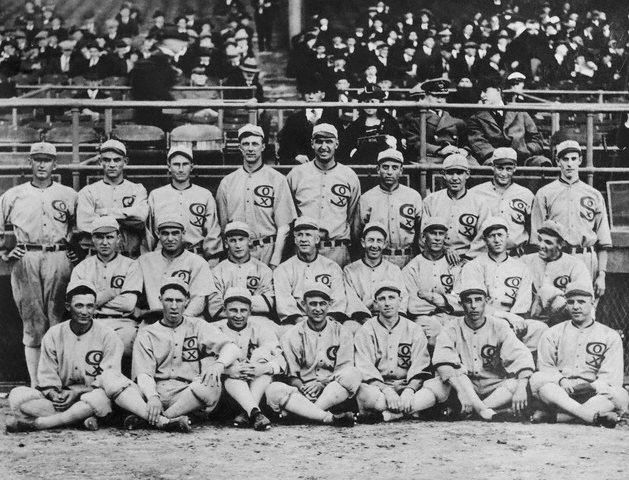
916. Eight Men Out: The Black Sox and the 1919 World Series (Eliot Asinof)

1919 Chicago White Sox team photo

Synopsis from Amazon:
The headlines proclaimed the 1919 fix of the World Series and attempted cover-up as "the most gigantic sporting swindle in the history of America!" First published in 1963, Eight Men Out has become a timeless classic. Eliot Asinof has reconstructed the entire scene-by-scene story of the fantastic scandal in which eight Chicago White Sox players arranged with the nation's leading gamblers to throw the Series in Cincinnati. Mr. Asinof vividly describes the tense meetings, the hitches in the conniving, the actual plays in which the Series was thrown, the Grand Jury indictment, and the famous 1921 trial. Moving behind the scenes, he perceptively examines the motives and backgrounds of the players and the conditions that made the improbable fix all too possible. Here, too, is a graphic picture of the American underworld that managed the fix, the deeply shocked newspapermen who uncovered the story, and the war-exhausted nation that turned with relief and pride to the Series, only to be rocked by the scandal. Far more than a superbly told baseball story, this is a compelling slice of American history in the aftermath of World War I and at the cusp of the Roaring Twenties.

My rating: 5 stars

My review: A great description and explanation of the 1919 Black Sox scandal. Very fairly told, with neither the players, the owners, or MLB (or the version back then) being blameless.

Sunday, January 20, 2008

856. Walden and Civil Disobedience (Henry David Thoreau)

Synopsis from Amazon UK:
"Walden" was the fruit of Thoreau's two-year stay on the Walden Pond. He carefully shaped the book to follow the natural cycle of the seasons, yet it is more than an account of life in the woods, it is a quest for personal freedom and individuality that evokes nature without being sentimental or distorting the natural world. Though widely reviewed at the time of publication, sales did not reflect the attention the book received. It has now become an American classic. "Civil Disobedience", was also based on Thoreau's experiences during the period he lived on the pond. In 1846, he was arrested for not having paid his poll tax, as a way of demonstrating that he did not recognize the authority of a government that "buys and sells men, women, and children." It is a treatise against slavery and a government that wages war to support injustice.

My rating: 4 stars

Sunday, November 4, 2007

759. Confederates in the Attic (Tony Horwitz)

Synopsis from Amazon:
Pulitzer Prize-winning journalist Tony Horwitz returned from years of traipsing through war zones as a foreign correspondent only to find that his childhood obsession with the Civil War had caught up with him. Near his house in Virginia, he happened to encounter people who reenact the Civil War--men who dress up in period costumes and live as Johnny Rebs and Billy Yanks. Intrigued, he wound up having some odd adventures with the "hardcores," the fellows who try to immerse themselves in the war, hoping to get what they lovingly term a "period rush." Horwitz spent two years reporting on why Americans are still so obsessed with the war, and the ways in which it resonates today. In the course of his work, he made a sobering side trip to cover a murder that was provoked by the display of the Confederate flag, and he spoke to a number of people seeking to honor their ancestors who fought for the Confederacy. Horwitz has a flair for odd details that spark insights, and Confederates in the Attic is a thoughtful and entertaining book that does much to explain America's continuing obsession with the Civil War.

My rating: 4 stars

Sunday, October 14, 2007

711. The Music of the Primes (Marcus Du Sautoy)

Bernhard Riemann

Synopsis from Amazon Canada:
In 1859, German mathematician Bernhard Riemann presented a paper to the Berlin Academy that would forever change the history of mathematics. The subject was the mystery of prime numbers. At the heart of the presentation was an idea that Riemann had not yet proved but one that baffles mathematicians to this day.

Solving the Riemann Hypothesis could change the way we do business, since prime numbers are the lynchpin for security in banking and e-commerce. It would also have a profound impact on the cutting-edge of science, affecting quantum mechanics, chaos theory, and the future of computing. Leaders in math and science are trying to crack the elusive code, and a prize of $1 million has been offered to the winner. In this engaging book, Marcus du Sautoy reveals the extraordinary history behind the holy grail of mathematics and the ongoing quest to capture it.

My rating: 5 stars

My review: A very good review of the Riemann Hypothesis and the implications of a proof. Technical enough for mathematicians but not so abstract that it cannot be understood by laypersons.

Wednesday, October 3, 2007

683. Moneyball (Michael Lewis)

Synopsis from Amazon UK:
Billy Beane, general manager of MLB's Oakland A's and protagonist of Michael Lewis's Moneyball had a problem: how to win in the Major Leagues with a budget that's smaller than that of nearly every other team. Conventional wisdom long held that big name, highly athletic hitters and young pitchers with rocket arms were the ticket to success. But Beane and his staff, buoyed by massive amounts of carefully interpreted statistical data, believed that wins could be had by more affordable methods such as hitters with high on-base percentage and pitchers who get lots of ground outs. Given this information and a tight budget, Beane defied tradition and his own scouting department to build winning teams of young affordable players and inexpensive cast-off veterans.

Lewis was in the room with the A's top management as they spent the summer of 2002 adding and subtracting players and he provides outstanding play-by-play. In the June player draft, Beane acquired nearly every prospect he coveted (few of whom were coveted by other teams) and at the July trading deadline he engaged in a tense battle of nerves to acquire a lefty reliever.

Besides being one of the most insider accounts ever written about baseball, Moneyball is populated with fascinating characters. We meet Jeremy Brown, an overweight college catcher who most teams project to be a 15th round draft pick (Beane takes him in the first). Sidearm pitcher Chad Bradford is plucked from the White Sox triple-A club to be a key set-up man and catcher Scott Hatteberg is rebuilt as a first baseman. But the most interesting character is Beane himself. A speedy athletic can't-miss prospect who somehow missed, Beane reinvents himself as a front-office guru, relying on players completely unlike, say, Billy Beane. Lewis, one of the top non-fiction writers of his era (Liar's Poker, Next), offers highly accessible explanations of baseball stats and his roadmap of Beane's economic approach makes Moneyball an appealing reading experience for business people and sports fans alike.

My rating: 5 stars

My review: A must-read for baseball fans.

Thursday, September 27, 2007

666 (Ack!). Shadow Divers (Robert Kurson)

Synopsis from Amazon UK:
February 1945. The war is almost over and Britain and America rule the waves. Sixty young Nazi soldiers are stranded underwater in U-Boat U-869 with barely enough fuel to make it home. The commander must decide whether to carry on to America and risk death in the pursuit of glory, or to admit defeat and return home. He decides to risk it. September 1991. Two deep-sea wreck divers receive a tip-off from a local fisherman about a site off the New Jersey coast. What they discover defies belief: a Nazi U-boat, 230 feet underwater. The recommended limit for diving is 130 feet, but John Chatterton and Richie Kohler know that if they don't take the risk, the mystery of the wreck will remain unsolved. Shadow Divers is the extraordinary story of the six-year quest for Hitler's lost sub. In the attempt to identify the sunken U-boat and its crew, the team teach themselves German, turn back fanatics and conspiracy theorists, and piece together an incredible story. In between, they make some of the most daring and dangerous scuba dives ever attempted. This is a gripping and compellingly readable account of human courage in the face of remarkable odds.

My rating: 4 stars

Saturday, May 26, 2007

339. The Meaning of Everything: The Story of the Oxford English Dictionary (Simon Winchester)

78 Banbury Road, Oxford -- the home of James Murray, editor of the OED

Synopsis from Amazon Canada:
Ask a logophile or crossword-puzzle addict what the holiest of holy reference works might be, and you're almost certain to receive a three-letter acronym in reply: the OED. Now in 20 volumes and still growing, the Oxford English Dictionary is an astounding monument, one that, like the Great Wall and the Roman Forum, seems to have been around forever. But, writes the always interesting explorer Simon Winchester in The Meaning of Everything, it took decades -- and considerable sums of money -- to bring it into being. The Scottish autodidact James Augustus Henry Murray, surrounded by a small army of underpaid and overworked helpers, laboured over it for more than half a century, seeing into print "a total of 227,779,589 letters and numbers, occupying fully 178 miles of type" that brought the elusive histories of words such as walrus (courtesy of J. R. R. Tolkien) and cow ("the female of any bovine animal," courtesy of Murray himself) into sharp relief.

My rating: 4 stars

Monday, May 14, 2007

221. The Hot Zone (Richard Preston)

Ebola virus

Synopsis from Amazon:
The dramatic and chilling story of an Ebola virus outbreak in a surburban Washington, D.C. laboratory, with descriptions of frightening historical epidemics of rare and lethal viruses. More hair-raising than anything Hollywood could think of, because it's all true.

My rating: 3 stars